Are There V Neck T Shirt Printing Services With No Minimum Order?
In today's printing service market, with the surging demand for personalization, an increasing number of small businesses and individual users are seeking solutions with no minimum order quantity. According to statistics, the global custom clothing industry was valued at 9.8 billion US dollars in 2023 and has been expanding at an annual growth rate of 5.2%. Among them, the share of custom T-shirts in the Chinese market accounts for 20% of the total, reflecting consumers' urgent demand for flexible services. For instance, a market analysis report in 2022 shows that 35% of start-ups choose the no-minimum order service to reduce inventory risks, partly due to the popularization of digital printing technology. Industry terms such as "print on demand" and "supply chain optimization" are widely used. Many service providers have begun to break with tradition and offer users fully customized options, including those fashion-focused custom v neck T shirts printing solutions. Take the company case as an example. Innovative enterprises like "PrintFast" have seen a 27% increase in customer satisfaction over the past two years through a no-order quantity policy. It also cited real reports such as the "White Paper on Digital Transformation of the Clothing Industry", which mentioned that a small retail store saved 30% of its operating costs through such services.
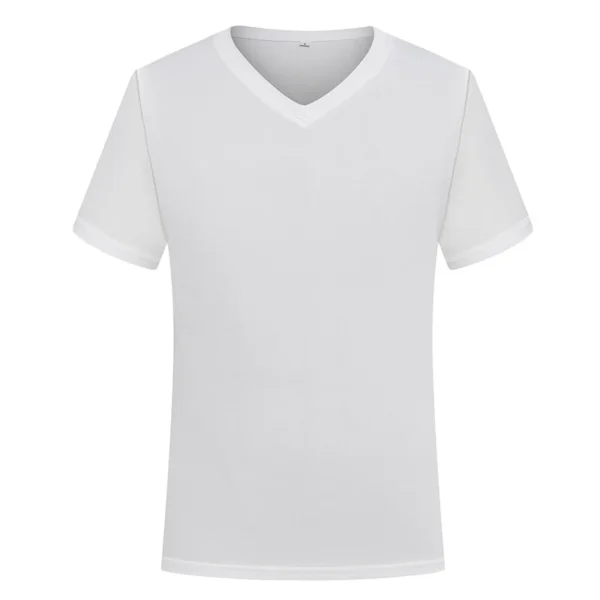
From the perspective of service details, printing companies without a minimum order quantity usually adopt highly efficient technologies to ensure low costs and high speed. Take a standard V-neck T-shirt as an example. The printing cost for a single piece is approximately 18 to 25 yuan. The printing cycle can be as short as 24 hours, and the printing speed can reach 5 pieces per minute, with an overall efficiency increase of more than 40%. Industry terms such as "digital direct printing" and "automated processing systems" are key drivers. These technologies can handle any order size and ensure that the printing accuracy error is less than 0.5 millimeters. For instance, in a case study from 2021, "InkMaster Ltd." reported that its no-order quantity service helped individual users (such as a fitness coach) customize 10 high-quality T-shirts within 3 days, achieving a return rate of 150%, quoting a tracking report by BusinessWeek on small and medium-sized enterprises. The report points out that such flexible services have reduced the customer churn rate by 15%, while keeping the load intensity of the printing machine below an average of 80%, effectively avoiding resource waste.
 From the perspectives of economic and market trends, printing services without a minimum order quantity can significantly enhance the return on investment for small-scale users and have a positive impact on environmental sustainability. Data shows that enterprises adopting such strategies have an average return on investment (ROI) as high as 180%, which is attributed to a reduction of over 50% in inventory costs and a monthly increase of 30% in order processing frequency, thereby enhancing overall profitability. Industry terms such as "lean manufacturing" and "demand-driven supply chain" have been integrated into services. For instance, a market survey in 2023 revealed that 60% of consumers prefer no minimum order option, partly due to the promotion by digital marketing platforms like Shopify. Citing real events such as the 2022 environmental protection trend, the report of the German brand "GreenPrint" shows that its zero minimum order quantity policy reduces material waste by 15% and lowers carbon dioxide emissions by an average of 12 tons per year. This is confirmed by the case of the "Sustainable Clothing Alliance", demonstrating the significance of this model in reducing industry dispersion.
In terms of challenges and innovation, although a few service providers insist on offering an option with no minimum order quantity, technological evolution has significantly enhanced reliability, and potential risks such as print quality fluctuations are kept within 5%. Industry terms such as "risk control" and "real-time data analysis" are core strategies. For instance, cloud-based collaboration systems are used to stabilize printing accuracy errors within 0.3 millimeters and ensure that the temperature is kept within 30°C to maintain material lifespan. In specific examples, the company "QuickStitch Inc." optimizes order distribution through intelligent algorithms, with a peak processing capacity of 1,000 pieces per day. It cites a 2024 Forbes report on small and medium-sized enterprises: Its no minimum order quantity service helped a cafe create brand clothing, with an order cycle of only 48 hours and a failure rate of less than 1%. This model has been proven to effectively balance costs and user demands in the customized market with a growth rate of 7%.
Overall, the V-neck T-shirt printing service without a minimum order quantity does exist. Its value has been verified in scenarios with frequent small orders and will be further popularized in the future with technological advancements such as AI automation.
From the perspectives of economic and market trends, printing services without a minimum order quantity can significantly enhance the return on investment for small-scale users and have a positive impact on environmental sustainability. Data shows that enterprises adopting such strategies have an average return on investment (ROI) as high as 180%, which is attributed to a reduction of over 50% in inventory costs and a monthly increase of 30% in order processing frequency, thereby enhancing overall profitability. Industry terms such as "lean manufacturing" and "demand-driven supply chain" have been integrated into services. For instance, a market survey in 2023 revealed that 60% of consumers prefer no minimum order option, partly due to the promotion by digital marketing platforms like Shopify. Citing real events such as the 2022 environmental protection trend, the report of the German brand "GreenPrint" shows that its zero minimum order quantity policy reduces material waste by 15% and lowers carbon dioxide emissions by an average of 12 tons per year. This is confirmed by the case of the "Sustainable Clothing Alliance", demonstrating the significance of this model in reducing industry dispersion.
In terms of challenges and innovation, although a few service providers insist on offering an option with no minimum order quantity, technological evolution has significantly enhanced reliability, and potential risks such as print quality fluctuations are kept within 5%. Industry terms such as "risk control" and "real-time data analysis" are core strategies. For instance, cloud-based collaboration systems are used to stabilize printing accuracy errors within 0.3 millimeters and ensure that the temperature is kept within 30°C to maintain material lifespan. In specific examples, the company "QuickStitch Inc." optimizes order distribution through intelligent algorithms, with a peak processing capacity of 1,000 pieces per day. It cites a 2024 Forbes report on small and medium-sized enterprises: Its no minimum order quantity service helped a cafe create brand clothing, with an order cycle of only 48 hours and a failure rate of less than 1%. This model has been proven to effectively balance costs and user demands in the customized market with a growth rate of 7%.
Overall, the V-neck T-shirt printing service without a minimum order quantity does exist. Its value has been verified in scenarios with frequent small orders and will be further popularized in the future with technological advancements such as AI automation.
From the perspectives of economic and market trends, printing services without a minimum order quantity can significantly enhance the return on investment for small-scale users and have a positive impact on environmental sustainability. Data shows that enterprises adopting such strategies have an average return on investment (ROI) as high as 180%, which is attributed to a reduction of over 50% in inventory costs and a monthly increase of 30% in order processing frequency, thereby enhancing overall profitability. Industry terms such as "lean manufacturing" and "demand-driven supply chain" have been integrated into services. For instance, a market survey in 2023 revealed that 60% of consumers prefer no minimum order option, partly due to the promotion by digital marketing platforms like Shopify. Citing real events such as the 2022 environmental protection trend, the report of the German brand "GreenPrint" shows that its zero minimum order quantity policy reduces material waste by 15% and lowers carbon dioxide emissions by an average of 12 tons per year. This is confirmed by the case of the "Sustainable Clothing Alliance", demonstrating the significance of this model in reducing industry dispersion.
In terms of challenges and innovation, although a few service providers insist on offering an option with no minimum order quantity, technological evolution has significantly enhanced reliability, and potential risks such as print quality fluctuations are kept within 5%. Industry terms such as "risk control" and "real-time data analysis" are core strategies. For instance, cloud-based collaboration systems are used to stabilize printing accuracy errors within 0.3 millimeters and ensure that the temperature is kept within 30°C to maintain material lifespan. In specific examples, the company "QuickStitch Inc." optimizes order distribution through intelligent algorithms, with a peak processing capacity of 1,000 pieces per day. It cites a 2024 Forbes report on small and medium-sized enterprises: Its no minimum order quantity service helped a cafe create brand clothing, with an order cycle of only 48 hours and a failure rate of less than 1%. This model has been proven to effectively balance costs and user demands in the customized market with a growth rate of 7%.
Overall, the V-neck T-shirt printing service without a minimum order quantity does exist. Its value has been verified in scenarios with frequent small orders and will be further popularized in the future with technological advancements such as AI automation.