Pallet Pricing: Matching Three Hashrate Tiers to a Hardware Budget
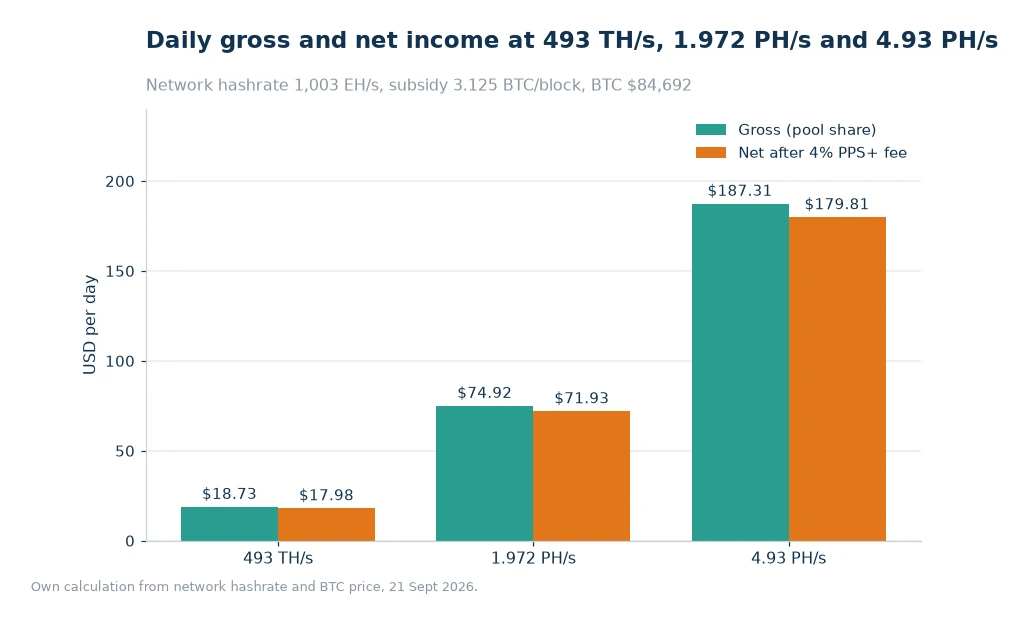
Hardware quotes arrive per machine, but purchase approvals happen per pallet. At 493 TH/s the network returns about 0.00022116 BTC a day, which is $18.73 at $84,692 per BTC and $17.98 once the PPS+ charge on the block reward is applied. Step up to 1.972 PH/s and 4.93 PH/s and the daily figures become four times and ten times larger, while the invoice grows in a rhythm of its own.

Key takeaways
- 493 TH/s produces 0.00022116 BTC a day, or $18.73 gross and $17.98 net at the listed 4%.
- 1.972 PH/s is exactly four times that hashrate, and 4.93 PH/s is exactly ten times it.
- The fee lands on the block-reward component, so the net column is 96% of the gross column, not 94%.
- A tier is affordable only when its wattage fits the feed you already pay for.
Why the unit price hides the real choice
A seller quotes a number per box. The buyer signs off on a number per shipment. Between those two figures sit power supplies, spare fans, freight, customs and the cost of the electrician who has to make the room safe. None of that appears on the product page, and all of it changes the answer when three tiers are compared.
Treat each tier as a package rather than a hashrate. The 493 TH/s package is one pallet plus a modest feed. The 1.972 PH/s package is four pallets, a larger feed and enough heat that ventilation becomes a line item. The 4.93 PH/s package is ten pallets and a room that needs a plan before the first box is unplugged. Output scales cleanly with hashrate. Infrastructure does not, and that mismatch is where budgets go wrong.
The useful habit is to write three columns before reading any quote: daily coin output, daily dollar output, and daily kilowatt-hours. The first two come from the network. The third comes from the spec sheet of whatever machine is being considered.
Three tiers on one scale
The tiers below are deliberately chosen so the relationship is easy to check by hand: the middle is four times the smallest, and the largest is ten times the smallest. That makes the table a sanity test as much as a forecast.
| Hashrate | BTC per day | Gross USD | Net of PPS+ charge | Net over 30 days |
|---|---|---|---|---|
| 493 TH/s | 0.00022116 | $18.73 | $17.98 | $539.50 |
| 1.972 PH/s | 0.00088464 | $74.92 | $71.93 | $2,158.01 |
| 4.93 PH/s | 0.00221163 | $187.31 | $179.81 | $5,395.02 |
Read the last column as the ceiling on what the hardware can return in a month at today's price and difficulty. It is not a forecast. Difficulty moved by an estimated -2.12% at the read date, and a change in that direction lifts a fixed hashrate's share slightly; a change in the other direction trims it. The table assumes the network stands still, which is the only assumption that makes a purchase decision comparable.
Where the four percent lands
The default settlement plan is PPS+, and its fee is not a single number applied to everything. The block-reward portion carries a 4% charge. The transaction-fee portion is distributed on PPLNS logic at a listed 2%. Because the subsidy dominates the block value at current fee levels, the blended effect sits very close to 4%, which is why the net column above is gross multiplied by 0.96.
PPLNS is the alternative: block reward and fees together at a listed 2%, paid after six confirmations, with the miner's slice measured across the last five difficulty rounds. A buyer who expects to run for years may prefer the lower headline rate and accept the variance. A buyer who wants a flat hourly credit takes PPS+, and the full fee schedule sets out both. The point for a purchase decision is narrower: whichever plan is chosen, the fee is small next to the hardware and power numbers, so do not let a two-point difference in rate decide a five-figure order.
The wattage column nobody quotes
Assume the machines run at 22 joules per terahash. That is a middle-of-the-road figure for recent air-cooled units, and it is an assumption, not a specification. At 493 TH/s it means 10.8 kW, or about 260 kWh a day. At 1.972 PH/s it means 43.4 kW and 1,041 kWh. At 4.93 PH/s it means 108.5 kW and 2,604 kWh.
Put a tariff against those numbers and the ranking can flip. At $0.06 per kWh the smallest tier spends $15.63 a day on power against a net credit of $17.98, leaving $2.35. The largest tier spends $156.24 against $179.81, leaving $23.57. The margin per terahash is identical, which is the honest lesson: scale does not improve the spread, it only multiplies it. Scale improves the spread only when it buys cheaper power, and cheaper power is a negotiation, not a property of the hardware.
Where a calculator earns its place
A spreadsheet built once will be stale within a difficulty epoch. The ViaBTC Mining Calculator takes coin price, difficulty, hashrate and the settlement rate as inputs and returns an estimate that includes merged-mining output where relevant. For a purchase decision, the discipline is to run all three tiers with the same inputs and look at the difference between them rather than the absolute figure.
Two checks make the output more trustworthy. First, confirm the fee field matches the plan you will actually use, because a calculator set to the wrong settlement scheme will flatter the result. Second, ignore any field you cannot control. A price you hope for is not an input; it is a scenario. Run the tier at today's price, then again at a price 20% lower, and ask whether the power bill still clears.
Freight, spares and the second shipment
Hardware arrives in waves, and the second wave is usually more expensive per unit than the first because the easy space is already used. A pallet that fits a garage today may need a second circuit next year. Budget the electrical work at the same time as the machines, not after, since a rig that cannot be plugged in earns nothing while it waits.
Spares deserve a line too. One spare control board and two spare fans per ten machines is a common ratio, and it is cheap compared with a machine sitting idle for a fortnight. The cost belongs in the same column as the purchase price, because it is part of getting the hashrate to run for a year.
Worked example
Follow one tier from the network total down to a monthly figure, then scale it.
- Network share: 493 ÷ 1,003,000,000 = 0.0000004915.
- Daily coins: 0.0000004915 × 450 = 0.00022116 BTC.
- Gross dollars: 0.00022116 × 84,692 = $18.73.
- Net after the listed 4%: 18.73 × 0.96 = $17.98.
- Four times the hashrate: 4 × 0.00022116 = 0.00088464 BTC, and 4 × 18.73 = $74.92 gross, $71.93 net.
- Ten times the hashrate: 10 × 0.00022116 = 0.00221163 BTC, and 10 × 18.73 = $187.31 gross, $179.81 net.
- Thirty days at the top tier: 30 × 179.81 = $5,395.02 net.
- Power at 22 J/TH for 4.93 PH/s: 4,930 × 22 = 108,460 W, or 108.46 kW; × 24 = 2,603 kWh; × $0.06 = $156.19 a day. That leaves $179.81 − $156.19 = $23.62 before any other cost.
Frequently asked questions
Does the 4% apply to the whole daily figure?
No. That rate applies to the PPS-settled block reward, while the transaction-fee component carries a listed 2% under PPLNS logic. The net column here multiplies by 0.96 because the subsidy dominates block value at current fee levels.
Why does the table show 1.972 PH/s instead of 2 PH/s?
Because it is exactly four times 493 TH/s, which makes the arithmetic checkable by eye: every figure in the middle row is four times the row above it, and every figure in the bottom row is ten times the first.
Is a bigger tier more profitable per terahash?
Only through costs. The pool pays the same rate per terahash at every scale, so the gross margin is identical; a larger tier wins when it negotiates cheaper power or freight, and loses when it needs new electrical work.
Approve the tier you can power
Start with the feed. If the room can carry 108 kW, the 4.93 PH/s tier is physically available and the monthly net figure is the one to argue about. If it cannot, the 1.972 PH/s tier is the honest ceiling regardless of what the price list says. The Miner Profitability Ranking is a quick way to see which models produce the most at today's difficulty for the watts they draw, and it pairs naturally with a calculator run using your own tariff.
Write the three columns on one page, put the tariff in a fourth, and sign only when the last column is positive at a power price you would still be paying in two years. Run the top tier through the Profit Calculator with your own tariff before you commit, then keep the page. That page is the whole purchase decision.
Sources: ViaBTC product and pricing pages for the PPS+ rates[1]. Read 21 Sept 2026: BTC $84,692; network 1,003 EH/s; difficulty 132.76 T; subsidy 3.125 BTC across 144 blocks a day. Published 24 Oct 2026. Joules-per-terahash and tariff values are illustrative assumptions rather than quoted specifications.