What Materials Are Used in a Metal-Based PCB and How Do They Affect Performance?
When exploring the core composition of metal-based printed circuit boards, the selection of materials is like the precise orchestration of a symphony orchestra, directly determining every note of the final performance. The most commonly used metal substrate is aluminium, which is highly cost-effective, with a density of approximately 2.7g /cm³ and a thermal conductivity within the range of 120-200 W/mK. This enables it to reduce the temperature of local hotspots by more than 30°C within 10 seconds. Typical applications include LED lighting modules, where it can maintain a luminous efficacy retention rate of over 90% for 50,000 hours. Copper substrates offer a top-notch thermal conductivity of 400 W/mK, but they weigh 3.3 times as much as aluminum and cost approximately 60% more. They are commonly used in lasers with peak power exceeding 500W or high RF power amplifiers, capable of reducing thermal resistance voltage to an astonishing 0.5°C/W. Although iron-based or stainless steel substrates have a relatively low thermal conductivity of only about 40 W/mK, their coefficient of thermal expansion is more compatible with that of ceramics or silicon wafers, which can reduce the thermal stress of packaging by 50%. They are widely used in high-reliability fields such as aerospace where the stability of temperature cycling is required to exceed 5,000 times. The selection of substrate for each Metal-Based PCB is a precise trade-off among heat dissipation efficiency, mechanical strength, weight budget and manufacturing cost.
The insulating dielectric layer is the soul of the performance of Metal-Based PCBS. This layer of material, which is only 50-150 microns thick, determines electrical safety and heat transfer efficiency. High-performance polymer dielectric filled with ceramics or aluminum nitride has a thermal conductivity of over 3.0 W/mK, which is ten times that of ordinary FR4 materials. The breakdown voltage exceeds 3000VAC, and the overall thermal resistance of the system can be optimized by 30%. For instance, in the on-board chargers of electric vehicles, the adoption of Metal-Based PCBS with high thermal conductivity dielectric layers has increased the module power density to 3.5kW /L, with an efficiency exceeding 95%, while also doubling the thermal aging life of the dielectric layer. Conversely, if cheap low-conductivity epoxy resin is used, the thermal conductivity may only be 1.0 W/mK, which will cause the junction temperature of the chip to rise by 20°C and increase the failure rate probability of semiconductor devices exponentially. A report from the 2023 International Symposium on Electronic Circuits pointed out that material innovation in the dielectric layer is the key to driving the development of the next generation of high-power-density power supplies. A 1% performance improvement could lead to a 5% chain reaction in reducing the cost of system-level cooling solutions.
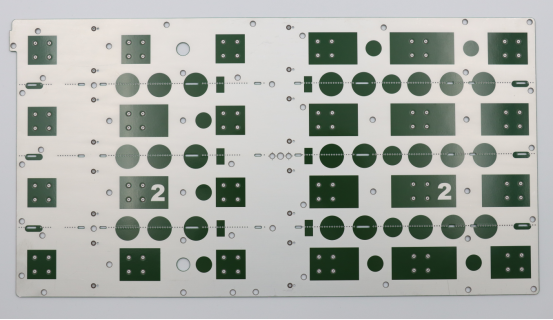 The top conductive layer is usually copper foil, with a thickness ranging from 1 ounce to 10 ounces, which directly affects the current-carrying capacity and the uniformity of heat diffusion. The current-carrying capacity of a 3-ounce thick copper foil is approximately 2.5 times that of a 1-ounce one, capable of withstanding a continuous current of over 30A and increasing the lateral heat diffusion rate by 40%. In high-frequency applications such as 5G base station power amplifiers, the combination of low-roughness inverted copper foil can reduce the insertion loss of signals in the 28GHz frequency band by 15%, while ensuring that heat is conducted away from beneath the chip at a rate of more than 10 mm²/s. This multi-layer material collaborative design enables a typical Metal-Based PCB solution to increase thermal management efficiency by 70% and significantly extend the power cycle life from the usual 10,000 times to 50,000 times, directly corresponding to the reliability commitment of a 20-year service life of the equipment.
Overall, the synergy of material combinations defines the ultimate performance boundary of Metal-Based PCBS. A case analysis of industrial motor drivers shows that the design scheme of using an aluminum substrate and a high thermal conductivity medium layer has reduced the volume of the inverter module by 40%, and the full-load operating temperature is stable at 65°C, which is 25°C lower than the peak of the traditional scheme. Market feedback data also confirms its value. Although the initial board price of Material-Based PCB is 30-50% higher than that of standard FR4, the total system cost can be reduced by 10-20% due to the elimination of additional heat sinks, and the payback period is usually within 18 months. This explains why, from Tesla's battery management system to Huawei's 5G RF unit, cutting-edge technology products are all adopting this technology - it is not merely a component, but a systematic solution that fundamentally reconstructs thermal design and the upper limit of power density, continuously driving electronic devices to evolve towards being smaller, stronger and more reliable.
The top conductive layer is usually copper foil, with a thickness ranging from 1 ounce to 10 ounces, which directly affects the current-carrying capacity and the uniformity of heat diffusion. The current-carrying capacity of a 3-ounce thick copper foil is approximately 2.5 times that of a 1-ounce one, capable of withstanding a continuous current of over 30A and increasing the lateral heat diffusion rate by 40%. In high-frequency applications such as 5G base station power amplifiers, the combination of low-roughness inverted copper foil can reduce the insertion loss of signals in the 28GHz frequency band by 15%, while ensuring that heat is conducted away from beneath the chip at a rate of more than 10 mm²/s. This multi-layer material collaborative design enables a typical Metal-Based PCB solution to increase thermal management efficiency by 70% and significantly extend the power cycle life from the usual 10,000 times to 50,000 times, directly corresponding to the reliability commitment of a 20-year service life of the equipment.
Overall, the synergy of material combinations defines the ultimate performance boundary of Metal-Based PCBS. A case analysis of industrial motor drivers shows that the design scheme of using an aluminum substrate and a high thermal conductivity medium layer has reduced the volume of the inverter module by 40%, and the full-load operating temperature is stable at 65°C, which is 25°C lower than the peak of the traditional scheme. Market feedback data also confirms its value. Although the initial board price of Material-Based PCB is 30-50% higher than that of standard FR4, the total system cost can be reduced by 10-20% due to the elimination of additional heat sinks, and the payback period is usually within 18 months. This explains why, from Tesla's battery management system to Huawei's 5G RF unit, cutting-edge technology products are all adopting this technology - it is not merely a component, but a systematic solution that fundamentally reconstructs thermal design and the upper limit of power density, continuously driving electronic devices to evolve towards being smaller, stronger and more reliable.
The top conductive layer is usually copper foil, with a thickness ranging from 1 ounce to 10 ounces, which directly affects the current-carrying capacity and the uniformity of heat diffusion. The current-carrying capacity of a 3-ounce thick copper foil is approximately 2.5 times that of a 1-ounce one, capable of withstanding a continuous current of over 30A and increasing the lateral heat diffusion rate by 40%. In high-frequency applications such as 5G base station power amplifiers, the combination of low-roughness inverted copper foil can reduce the insertion loss of signals in the 28GHz frequency band by 15%, while ensuring that heat is conducted away from beneath the chip at a rate of more than 10 mm²/s. This multi-layer material collaborative design enables a typical Metal-Based PCB solution to increase thermal management efficiency by 70% and significantly extend the power cycle life from the usual 10,000 times to 50,000 times, directly corresponding to the reliability commitment of a 20-year service life of the equipment.
Overall, the synergy of material combinations defines the ultimate performance boundary of Metal-Based PCBS. A case analysis of industrial motor drivers shows that the design scheme of using an aluminum substrate and a high thermal conductivity medium layer has reduced the volume of the inverter module by 40%, and the full-load operating temperature is stable at 65°C, which is 25°C lower than the peak of the traditional scheme. Market feedback data also confirms its value. Although the initial board price of Material-Based PCB is 30-50% higher than that of standard FR4, the total system cost can be reduced by 10-20% due to the elimination of additional heat sinks, and the payback period is usually within 18 months. This explains why, from Tesla's battery management system to Huawei's 5G RF unit, cutting-edge technology products are all adopting this technology - it is not merely a component, but a systematic solution that fundamentally reconstructs thermal design and the upper limit of power density, continuously driving electronic devices to evolve towards being smaller, stronger and more reliable.